HDPE Corrugated Pipe vs. Concrete and PVC Pipes: Why Choose HDPE?
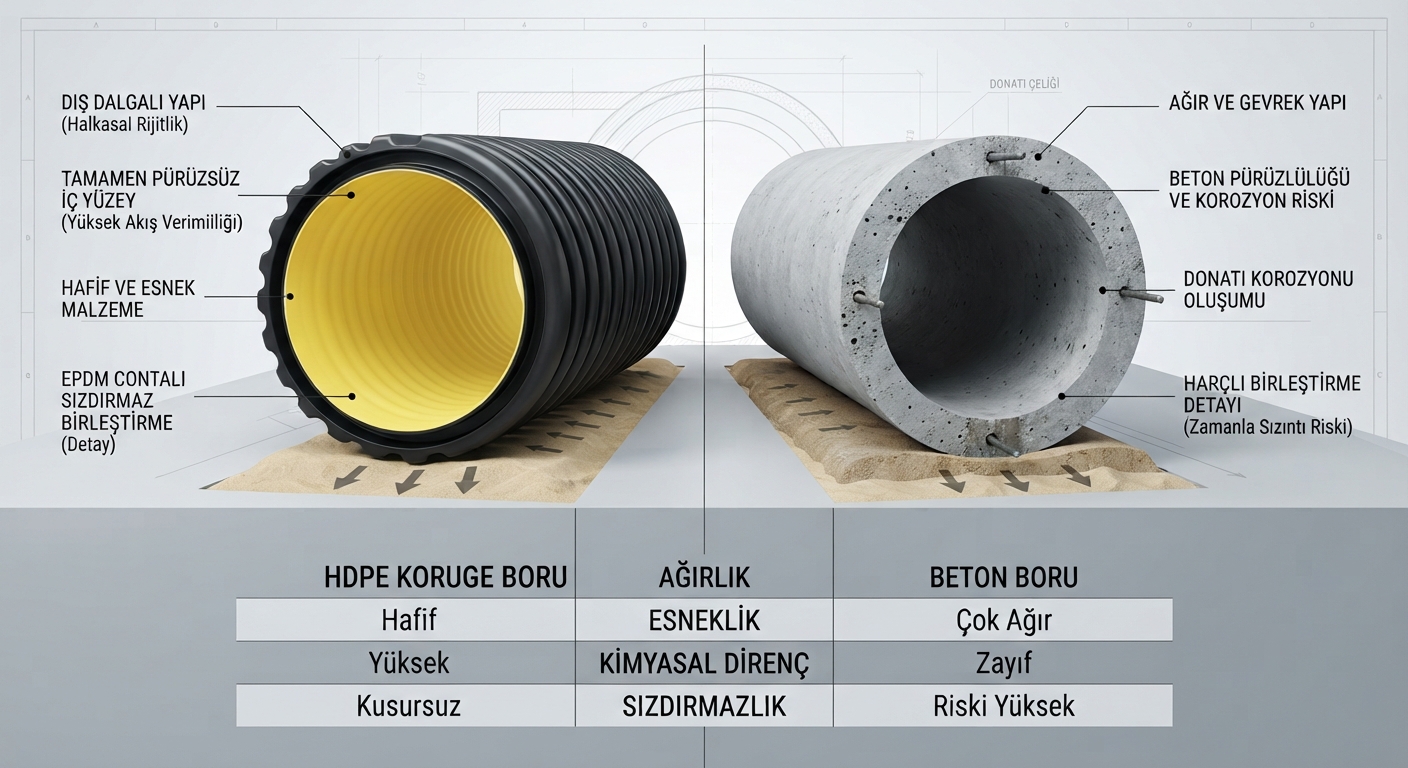
Sewer, stormwater, drainage and wastewater networks are essential long-term investments for safe and healthy cities. Choosing the right pipe material determines the balance between savings, durability and operating cost. Traditional concrete pipes and smooth PVC pipes are increasingly compared with engineered HDPE corrugated pipes.
This guide examines the technical and economic advantages of HDPE corrugated pipe over concrete and PVC alternatives.
1. Material Properties and Strength: Flexibility or Brittleness?
Infrastructure pipes face heavy traffic loads, soil settlement and ground movement.
- Concrete pipes: They are geotechnically brittle. Settlement, earthquakes and sudden loads can cause cracking, breakage and leakage at joints. Their weight complicates transport and installation.
- Smooth PVC pipes: Their rigid structure has limited impact resistance, especially in large diameters, and can become more brittle in cold weather.
- HDPE corrugated pipes: Their double-wall structure and flexible polyethylene share loads with the surrounding backfill. They adapt to ground movement and reduce the risk of cracking and breakage.
2. Leak Tightness and Environmental Safety
Watertightness prevents wastewater from entering soil and groundwater and prevents groundwater infiltration from increasing treatment plant loads.
- Concrete pipes: Mortar or simple gasket joints may deteriorate with soil movement and chemical wear, causing leakage, erosion and road settlement.
- HDPE corrugated pipes: Factory-made EPDM gaskets and socket systems provide reliable sealing, including when the line experiences angular movement.
3. Chemical Resistance and Abrasion Performance
Sewage and industrial wastewater can contain aggressive chemicals, hydrogen sulfide (H2S) and acidic compounds.
- Concrete pipes: Vulnerable to acidic environments and chemical corrosion, especially crown corrosion. The inner surface can wear and become rough.
- PVC pipes: Resistant to many chemicals but may be sensitive to long-term UV exposure and some solvents.
- HDPE corrugated pipes: Chemically inert and highly resistant to acids, bases, salt water and sewer gases. Their abrasion resistance limits the effect of suspended solids.
4. Transport, Logistics and Installation Cost
Total project cost includes more than the pipe price: transport, unloading, labor and installation time are also important.
- Concrete pipes: Their weight limits transport capacity and requires cranes and special equipment on site.
- HDPE corrugated pipes: Their low weight allows economical shipment of high meterage, reduces crane requirements and speeds trench installation with small equipment.
5. Hydraulic Performance and Flow Efficiency
The corrugated outer wall contributes to ring stiffness classes such as SN4 and SN8, while the inner wall remains smooth. Low hydraulic friction improves flow efficiency and reduces sediment buildup and blockage risk.
6. Summary Comparison Table
| Feature | HDPE Corrugated | Concrete | Smooth PVC |
|---|---|---|---|
| Flexibility and impact resistance | Very high | Low, brittle | Medium, brittle in cold |
| Service life | 50-100 years | 30-50 years | 30-40 years |
| Watertightness | Excellent, gasketed | Risk increases over time | Good, gasket dependent |
| Chemical and gas resistance | Excellent | Weak | Good |
| Weight and transport | Light and economical | Very heavy | Light/medium |
| Installation speed | Very fast | Slow | Fast |
Conclusion: Why Choose HDPE Corrugated Pipe?
Concrete pipes can be limited by their weight and corrosion weaknesses, while smooth PVC pipes may face strength and brittleness limits in large diameters.
HDPE corrugated pipes reduce transport and labor costs through their low weight, adapt to ground movement through flexibility, and provide long service life through chemical resistance. For projects seeking more than 50 years of service, low maintenance cost and strong hydraulic performance, HDPE corrugated pipe is a powerful choice.
HDPE Corrugated Pipe Comparison